Thinking, Fast and Slow

A book was written by Daniel Kahneman, a Nobel Prize of Economics winner in 2002.

  • This book introduces a fact that our brain is running with system 1 and system 2.

System 1 is also called the “automatic system”, which is controlled by our innate and automatic consciousness. System 2 is also called “effortful system”, which could be understood as the ability to actively control our common-sense – system 1. However, system 2 takes more working memory that is limited in our brain, so doing anything using system 2 would reduce your ability to think.

System 2 also monitor the suggestion of System 1, modifying and adjusting the direct conscious idea of System 1.

System 2 has limited capacity. Two aspects of effortful tasks are (1) difficulty of the question, and (2) thinking fast the get the results.

  • Pupils are sensitive indicators of mental efforts.

Pupils dilate substantially when people make two digits multiplication, and they dilate more this problem is harder. People, when engaged in a mental sprint, may become effectively blind.

  • Ego depletion refers to the idea that self-control or willpower draws upon a limited pool of mental resources that can be used up

System 2 has limits.

  • Self-control requires efforts and attentions. Or says, controlling thoughts and behaviours is one of the tasks that system 2 performs.

Remember system 2 has limits.

Activities that impose high demands on system 2 require self-control, and the exertion of self-control is depleting and unpleasant. After exerting self-control in one task, you do not feel like making an effort in another, although you could do it if you really had to.

Maintenance of a coherent train of thought and the occasional engagement in effortful thinking also requires self-control.

  • The nervous system consumes more glucose than most other parts of the body, and effortful mental activity appears to be especially expensive in the currency of glucose.
Surprised Finding from the Book-Thinking, Fast and Slow

Currently, I am reading a book, Thinking, Fast and Slow, which is written by Daniel Kahneman. In this book, the author mentioned a person called Amos several times. As I am pretty interested in the findings and statements in this book, I went to search for who Amos is.

A report caught my eye.

https://www.newyorker.com/books/page-turner/the-two-friends-who-changed-how-we-think-about-how-we-think

That report is written by Cass R. Sunstein and Richard Thaler, two famous psychologists or behaviour economists. Especially, Professor Thaler, if my remembering is not wrong, aroused many ideas about behavioural economics and won the Nobel Prize as well. In this report, they mentioned their Two Friends Who Changed How We Think About How We Think, and their friends clearly are Daniel and Amos.

I am pretty surprised that I find the connection between those famous and legendary economists and psychologists, and decide to keep digging in their previous studies.

Lagrange Multiplier

Here is a review of the method of Lagrangian method. We find that maximising a utility function s.t. a budget constant by using Lagrangian could also get the MRS.

$$\max_{x,y} U(x,y)\quad s.t.\quad BC$$

Or, in a Cobb-Douglas utility.

$$\max_{x,y} x^a y^b\quad s.t.\quad p_x x+p_y y\leq w $$

Using the Lagrange Multiplier,

$$\mathcal{L}=x^a y^b +\lambda (w-p_x x- p_y y)$$

Discuss the complementary slackness, and take F.O.C.

$$ \frac{\partial \mathcal{L}}{\partial x}=0 \Rightarrow a x^{a-1}y^b=\lambda p_x $$

$$ \frac{\partial \mathcal{L}}{\partial y}=0 \Rightarrow x^a b y^{b-1}=\lambda p_y $$

Divide those two equations then we get,

$$ \frac{MU_x}{MU_y}=\frac{ay}{bx}=\frac{p_x}{p_y}=MRS_{x,y} $$

After knowing the Marshallian Demandm \(x=f(p_x,p_y,w)\), we can then calculate the elasticity.

  • \(\varepsilon=\frac{\partial x}{\partial p_x}\frac{p_x}{x}\), elasticity to price of x.
  • \(\varepsilon_I=\frac{\partial x}{\partial w}\frac{w}{x}\), elasticity to wealth.
  • \( \varepsilon_{xy}=\frac{\partial x}{\partial p_y}\frac{p_y}{x} \), elasticity to price of y.

Meaning of Lambda

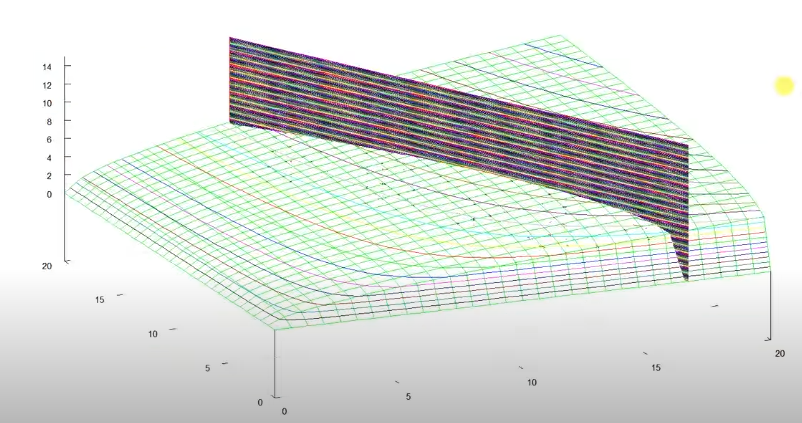
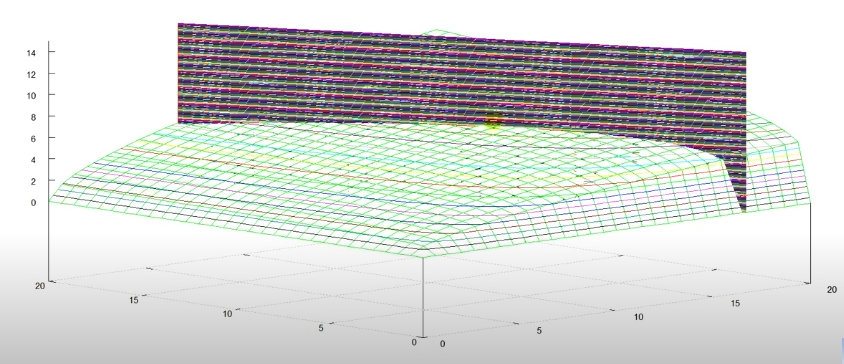
Review the graphic version of the utility maximisation problem, the budget constraint is the black plane, the utility function is green, and the value of utility is the contour of the utility function.

After solving the utility maximisation problem, we would get \(x^*\) and \(y^*\) (they have exact values). Then, plug them back into the F.O.C., we get easily get the numerical value of \(\lambda\).

As \(\frac{\partial \mathcal{L}}{\partial w}=\lambda\), \(\lambda\) represents how does the utility changes if wealth changes a unit.

\(\lambda\) is like the slope of the utility surface. With the increase, the wealth, the budget constraint (the black wall) moves outwards, and then the changes would result in an increase of the utility value, which is the intersection of the utility surface and the budget constraint surface.

Similarly, the utility function could be replaced with production and has a similar implication of output production.

Geographical Meaning

\(\lambda\) is when the gradient of the contour of the utility function is in the same direction as the gradient of constraint. Or says, the gradient of \(f\) is equal to the gradient of \(g\).

In another word, the Lagrange multiplier \(\lambda\) gives the max and min value of \(x\) and \(y\), and also the corresponding changing speed of those max or mini values of our objective function, \(f\), if the constraint, \(g\), releases.

Lagrange Multiplier:

Simultaneously solve \(\nabla f=\lambda\nabla g\), and \(g=0\). \(f\) here is the objective function (utility function in our case), and \(g\) here is the constraint (the budget constraint in our case).

Reference

Thanks to the video from Professor Burkey, that helps a lot to let me rethink the meaning of lambda.

https://www.youtube.com/watch?v=O3MFXT7AdPg

And the geographic implication of Lagrange multiplier method.

https://www.youtube.com/watch?v=8mjcnxGMwFo

MRS and MRTS

Derivations

We here derive why \(MRS_{x,y}=\frac{MU_x}{MU_y}\).

Let \(U(x,y)=f(x,y)\), and we know, by definition, MRS measures how many units of x is needed to trade y holding utility constant. Thus, we keep the utility function unchanged, \(U(x,y)=C\), and take differentiation and find \(-dy/dx\).

$$f(x,y) dx=C dx$$

$$ \frac{\partial f(x,y)}{x}+\frac{\partial f(x,y)}{\partial y}\frac{\partial y}{\partial x}=0 $$

$$\frac{\partial y}{\partial x}=-\frac{\frac{\partial f(x,y)}{\partial x}}{\frac{\partial f(x,y)}{\partial y}}=\frac{MU_x}{MU_y}$$

Therefore,

MRS_{x,y}=-\frac{dy}{dx}=\frac{MU_x}{MU_y}

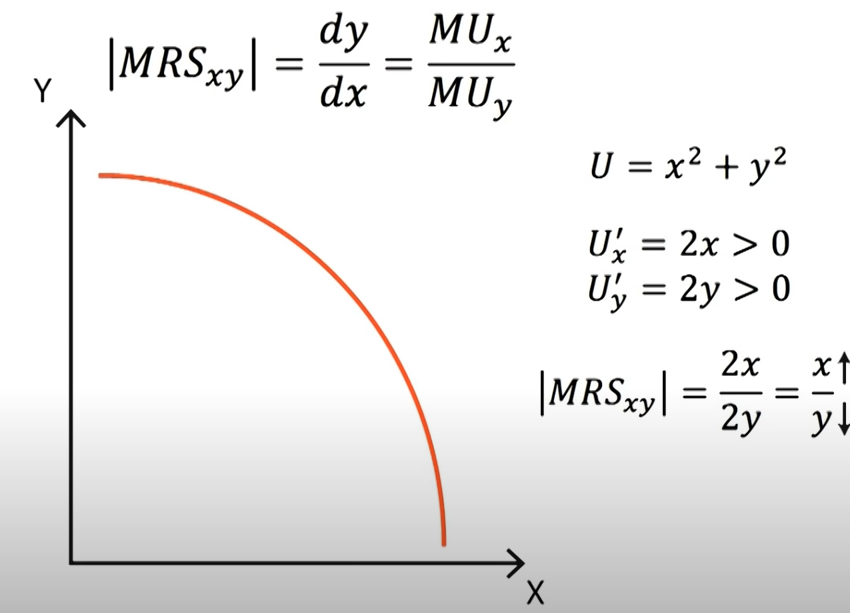
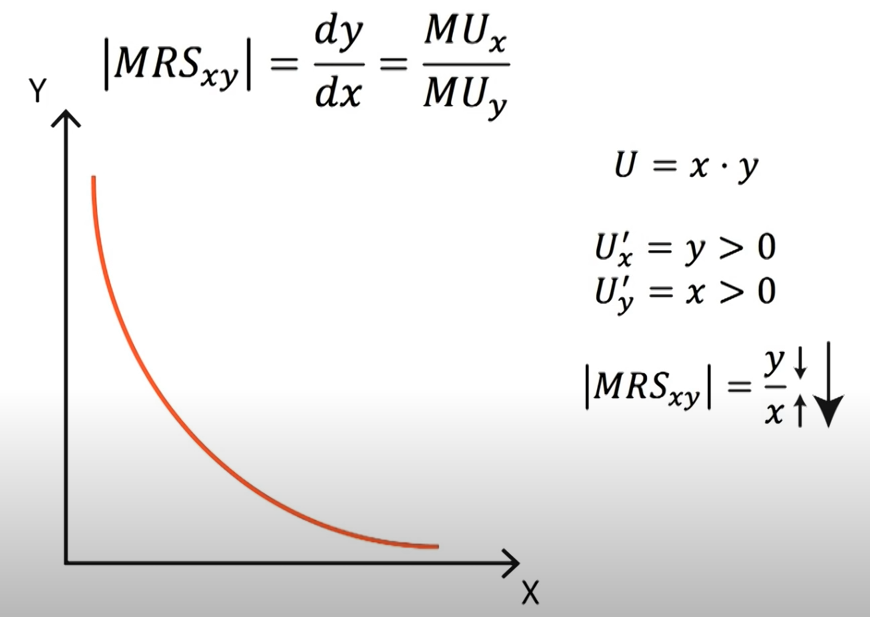
$$|MRS_{x,y}|=-\frac{dy}{dx}=\frac{MU_x}{MU_y} $$

Example 1

$$U=x^2+y^2$$

$$MRS_{x,y}=\frac{MU_x}{MU_y} =\frac{x}{y}$$

Example 2

$$U=x\cdot y$$

, which is similar as the Cobb-Douglas form but has exponenets zero.

$$MRS_{x,y}=\frac{MU_x}{MU_y} =\frac{y}{x}$$

Example 3

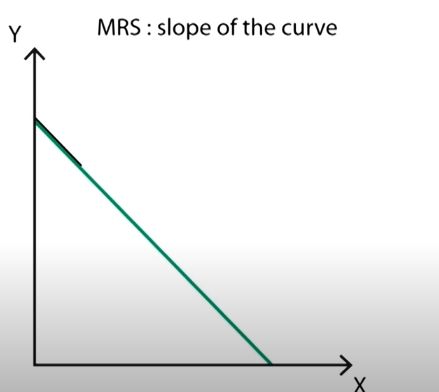
Perfect Substitution: MRS constant
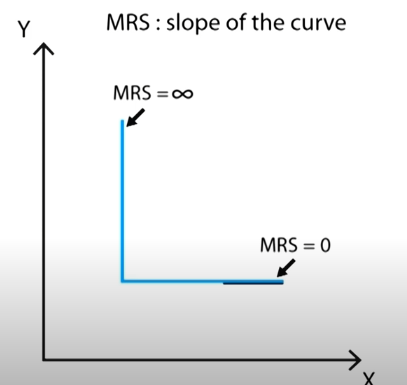
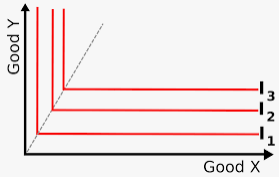
Perfect Complement

MRTS

Marginal Rate of Technical Substitution (MRTS) measures the amount of cost which a specific input can be replaced for another resource of production while maintaining a constant output.

$$MRTS_{K,L}=-\frac{\Delta K}{\Delta L}=-\frac{d K}{d L}=\frac{MP_L}{MP_K}$$

How to derive that?

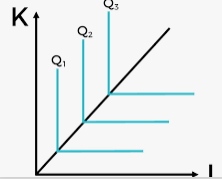
Recall the Isoquant that is equivalent to the contour line of the output function. MRTS is like the slope of the isoquant line. We let,

$$Q=L^a K^b$$

Then,

$$MP_K=\frac{\partial Q}{\partial K}=b L^A K^{b-1}$$

$$MP_L=\frac{\partial Q}{\partial L}=a L^{a-1}K^b$$

$$MRTS=\frac{ b L^A K^{b-1} }{ a L^{a-1}K^b }=\frac{aK}{bL}$$

In short, MRTS is a similar concept to MRS, but in the output aspect.

Cobb-Douglas Function

Cobb-Douglas Utility function

$$U=C x^a y^b$$

While applying the Cobb-Douglas formed utility function, we are actually proxy the preference of people. (The utility function is like a math representation if individuals’ preference is rational). In the utility function, we are focusing more on the Marginal Rate of Substitution between goods.

$$MRS_{x,y}=\frac{MU_x}{MU_y}=\frac{\partial U/\partial x}{\partial U/\partial y}=\frac{Cax^{a-1}y^b}{Cx^a by^{b-1}}$$

$$MRS_{x,y}=\frac{ay}{bx}$$

P.S. Cobb-Douglas gives the same MRS to CES utility function. While solving the utility maximisation problem, we take partial derivatives to the lagrangian and then solve them. Those steps are similar to calculating the MRS.

The key is that the number or value of the utility function does not matter, but the preference represented by the utility function is more important. Any positive monotonic transformation will not change the preference, such as logarithm, square root, and multiply any positive number.

Exponents Do Not Matter

The powers of the Cobb-Douglas function does not really matter as long as they are in the “correct” ratio. For example,

$$ U_1=Cx^7y^1,\quad and \quad U_2=Cx^{7/8}y^{1/8} $$

$$MRS_1=\frac{7y}{x}\quad and \quad MRS_2=\frac{7y/8}{x/8}=\frac{7y}{x}$$

Therefore, we can find that those two utility functions represent the same preference!

Or we can write \(U_1=(U_2)^8 \cdot C^{-7}\). Both taking exponent and multiplying a positive constant are positive monotonic transformations. Therefore, the powers of Cobb-Douglas do not really matter to represent the preference. (\(U=Cx^a y^{1-a}\) the exponents of the utility function does not have to be sum to one).

$$U=x^a y^b \Leftrightarrow x^{\frac{a}{a+b}}y^{\frac{b}{a+b}}$$

Constant Elasticity of Substitution

CES could be either production or utility function. It provides a clear picture of how producers or consumers choose between different choices (elasticity of substitution).

CES Production

The two factor (capital, labour) CES production function was introduced by Solow and later made popular by Arrow.

$$Q=A\cdot(\alpha K^{-\rho}+(1-\alpha)L^{-\rho})^{-\frac{1}{\rho}}$$

  • \(\alpha\) measures the relative proportion spent across K and L.
  • \(\rho=\frac{\sigma-1}{\sigma}\) is the substitution parameter.
  • \(\sigma=\frac{1}{1-\rho}\) is the elasticity of substitution.

While identical producers maximise their profits and markets get competitive, Marginal Product of Labour and Marginal Product of Capital follow,

$$MP_L=\frac{\partial Q}{\partial L}=w$$

$$MP_K=\frac{\partial Q}{\partial K}=r$$

So we get,

$$ \frac{w}{r}=\frac{1-\alpha}{\alpha}(\frac{K}{L})^{\rho+1} $$

$$\frac{K}{L}=(\frac{\alpha}{1-\alpha}\frac{w}{r})^{\frac{1}{1+\rho}}$$

Here, we get the substitution of K and L is a function of the price, w & r. As we are studying the elasticity of substitution, in other words how W/L is affected by w/r, we take derivatives later. We denote \(V=K/L\), and \(Z=w/r\). Then,

$$V=(\frac{\alpha}{1-\alpha}Z)^{\frac{1}{1+\rho}}$$

The Elasticity of Substitution (the percentage change of K/L in terms of the percentage change of w/r) is,

$$ \sigma=\frac{dV/V}{dZ/Z}=\frac{dV}{dZ}\frac{Z}{V}=\frac{1}{1+\rho} $$

Therefore, we get the elasticity of substitution becomes constant, depending on \(\rho\). The interesting thing happens here.

  • If \(-1<\rho<0\), then \(\sigma>1\).
  • If \(0<\rho<\infty\), then \(\sigma<1\).
  • If \(\rho=0\), then, \(\sigma=1\).

Utility Function

Marginal Rate of Substitution (MRS) measures the substitution rate between two goods while holding the utility constant. The elasticity between X and Y could be defined as the following,

$$ Elasticity=\frac{\%\Delta Y}{\% \Delta X}=\frac{\Delta Y/Y}{\Delta X/X}=\frac{X/Y}{\Delta X/\Delta Y} $$

The elasticity of substitution here is defined as how easy is to substitute between inputs, x or y. In another word, the change in the ratio of the use of two goods w.r.t. the ratio of their marginal price. In the utility function case, we can apply the formula,

$$\sigma=\frac{\Delta ln(X/Y)}{\Delta ln(MRS_{X,Y})}=\frac{\Delta ln(X/Y)}{\Delta ln(U_x/U_y)}= \frac{\Delta ln(X/Y)}{\Delta ln(U_x/U_y)} $$

$$\sigma=\frac{\frac{\Delta(X/Y)}{X/Y}}{\frac{\Delta (p_x/p_y)}{p_x/p_y}}$$

  • \(U_x=\frac{\partial U}{\partial X}=p_x\)
  • \(MRS_{X,Y}=\frac{dy}{dx}=\frac{U_x}{U_y}=p_x/p_y\) marginal price in equilibrium.

In the

$$ u(x,y)=(a x^{\rho}+b y^{\rho})^{1/\rho} $$

$$\sigma=\frac{1}{1-\rho}$$

If \(\rho=1\), then \(\sigma\rightarrow \infty\).

If \(\rho\rightarrow -\infty\), then \(\rho=0\).

Two common choices of CES production function are (1) Walras-Leontief-Harrod-Domar function; and (2) Cobb-Douglas function (P.S. but CES is not perfect, coz sigma always equal one).

As \(\rho=1\), the utility function would be a perfect substitute.

As \(\rho=-1\), the utility function would be pretty similar to the Cobb-Douglas form.

Later, the CES utility function could be applied to calculate the Marshallian demand function and Indirect utility function, and so on. Also, easy to show that the indirect utility function \(U(p_x,p_y,w)\) is homogenous degree of 0.

Reference

Arrow, K.J., Chenery, H.B., Minhas, B.S. and Solow, R.M., 1961. Capital-labor substitution and economic efficiency. The review of Economics and Statistics43(3), pp.225-250.

Ideas about Irrational Market Modelling

Continue with the idea that markets are uncompetitive. At the micro-level, the market is constituted by rational players, which takes proportion \(p\) and irrational ones, \(1-p\). They together make the whole market unresponded.

  • A potential study may focus on (1). the drivers of \(p\). (2). modelling the irrational market, establishing a model from micro to macro.
  • For (1), positive feedback or negative feedback may behave differently. Need some psychological knowledge and natural experiment.
  • Using how does market react to positive or negative shocks to distinguish the irrational proportion of people.

Causal Inference in Statistics

Base: Correlation does not mean casualty.

  • If X and Y are statistically dependent, X does not necessarily cause Y (or Y cause X). 相关性不代表有因果性
  • If X causes Y, then X & Y are very likely to be statistically dependent (but not always, there is extreme condition). 但是因果性代表相关性

Study 1. V Structure:

  • Chain

$$ X\rightarrow Y\rightarrow Z $$

Z and X are likely dependent. However, Z and X are independent, conditional on Y.

$$ P(Z=z|X=x,Y=c)=P(Z=z|Y=c) $$i.e.

i.e.

\(f_x: X=u_x\)

\(f_y: Y=84-X+u_Y := c\)

\(f_z: Z=100\underbrace{Y}_{c}+u_z\)

Now, Z and X are independent.

Therefore, we know, in the Chain:

$$ X\equiv Z$$

$$ X\bot Z|Y $$

  • Folk

$$ Y\leftarrow X\rightarrow Z $$

Y and Z are likely dependent. However, Y and Z are independent conditional on X.

$$P(Z=z|Y=y, X=c)=P(Z=z|X=c)$$

While conditioning on intermediate node X, then Z and Y are independent.

$$Y\bot Z|X$$

  • Collider

$$ X\rightarrow Z\leftarrow Y $$

X and Y are independent. However, X and Y are dependent conditional on Z.

$$ P(X=x|Y=y, Z=c)\neq P(X=x|Z=c) $$

i.e.

If we know \(Z=X+Y+u_Z:=c\), then \( X=c-Y-u_Z\), and thus X and Y become dependent conditional on \(Z=c\). Otherwise, \(X=u_X\) and \(Y=u_Y\).

Once, conditioning on \(Z\), the way gets connected. Otherwise (unconditional), we get independent.

P.S. Descendent of Z:

$$ X (or\ Y)\rightarrow Z\rightarrow W $$

Similarly, we get in the Collider:

$$ X\bot Y $$

$$ X\equiv Y|Z $$

$$ X\equiv Y |W $$

  • See notes for further studies.

Reference

Pearl, J., Glymour, M. and Jewell, N.P., 2016. Causal inference in statistics: A primer. John Wiley & Sons.

退休感言-孙振耀(HP大中华区总裁)

职业生涯就像一场体育比赛,有初赛、复赛、决赛。初赛的时候大家都刚刚进社会,大多数都是实力一般的人,这时候努力一点认真一点很快就能让人脱颖而出,于是有的人二十多岁做了经理,有的人迟些也终于赢得了初赛,三十多岁成了经理。然后是复赛,能参加复赛的都是赢得初赛的,每个人都有些能耐,在聪明才智上都不成问题,这个时候再想要胜出就不那么容易了,单靠一点点努力和认真还不够,要有很强的坚忍精神,要懂得靠团队的力量,要懂得收服人心,要有长远的眼光……看上去赢得复赛并不容易,但,还不是那么难。因为这个世界的规律就是给人一点成功的同时让人骄傲自满,刚刚赢得初赛的人往往不知道自己赢得的仅仅是初赛,有了一点小小的成绩大多数人都会骄傲自满起来,认为自己已经懂得了全部,不需要再努力再学习了,他们会认为之所以不能再进一步已经不是自己的原因了。虽然他们仍然不好对付,但是他们没有耐性,没有容人的度量,更没有清晰长远的目光。

职业生涯要关注自己想要什么。人都是要面子的,也是喜欢攀比的,即使在工作上也喜欢攀比,不管那是不是自己想要的。但是攀比并非是好的。

好工作,应该是适合你的工作,具体点说,应该是能给你带来你想要的东西的工作,你或许应该以此来衡量你的工作究竟好不好,而不是拿公司的大小,规模,外企还是国企,是不是有名,是不是上市公司来衡量。

我还是过普通人的日子,要普通人的快乐,至少,晚上睡得着觉。

工作是一件需要理智的事情,所以不要在工作上耍个性。你所在的公司并没有那么烂,你认为不错的公司也没有那么好。35岁以前我们的生存资本靠打拼,35岁以后生存的资本靠的就是积累,这种积累包括人际关系,经验,人脉,口碑……

一份工作到两三年的时候,大部分人都会变成熟手,这个时候往往会陷入不断的重复,有很多人会觉得厌倦,有些人会觉得自己已经搞懂了一切,从而懒得去寻求进步了。很多时候的跳槽是因为觉得失去兴趣了,觉得自己已经完成比赛了。其实这个时候比赛才刚刚开始

并不是你的每一份努力都会得到回报,并不是你的每一次坚持都会有人看到,并不是你每一点付出都能得到公正的回报,并不是你的每一个善意都能被理解……这个,就是世道。好吧,世道不够好,可是,你有推翻世道的勇气么?如果没有,你有更好的解决办法么?有很多时候,人需要一点耐心,一点信心。每个人总会轮到几次不公平的事情,而通常,安心等待是最好的办法。

逆境,是上帝帮你淘汰竞争者的地方。要知道,你不好受,别人也不好受,你坚持不下去了,别人也一样,千万不要告诉别人你坚持不住了,那只能让别人获得坚持的信心,让竞争者看着你微笑的面孔,失去信心,退出比赛。胜利属于那些有耐心的人。

第一件是入行,第二件事情是跟人。要做对的事情,不要让自己今后几十年的人生总是提心吊胆,更不值得为了一份工作赔上自己的青春年华。

好的领导的标准: 首先,好领导要有宽广的心胸,忍住脾气,忍得了比自己强的人;其次,领导要愿意从下属的角度来思考问题,这一点其实是从面试的时候就能发现的,如果这位领导总是从自己的角度来考虑问题,几乎不听你说什么,这就危险了。第三,领导敢于承担责任,如果出了问题就把责任往下推,有了功劳就往自己身上揽,这样的领导不跟也罢。

多认识一些人,多和比自己强的人打交道,同样能找到好的老师,不要和一群同样郁闷的人一起控诉社会,控诉老板,这帮不上你,只会让你更消极。和那些比你强的人打交道,看他们是怎么想的,怎么做的,学习他们,然后跟更强的人打交道。

公司小的时候是销售主导公司,而公司大的时候是财务主导公司,销售的局限性在于只看人情不看数字,财务的局限性在于只看数字不看人情。

人生的三个阶段:一个阶段是为现实找一份工作,一个阶段是为现实,但可以选择一份自己愿意投入的工作,一个阶段是为理想去做一些事情。

近期经济情况 Omicron

  • 当前报道表面Omicron杀伤力较弱。结合其传染力强的特点,有可能帮助全球实现群体免疫。由此US市场普遍对pandemic的预期减弱。
  • 目前Fed政策急转向收紧流动性,减少印钞并加息。市场普遍认为是因为目前美国高通胀。CPI创31年新高(此前是oil crisis)。但是potential reason是,美国就业市场以近饱和,近full employment。继续宽流动性刺激就业会导致hyperinflation。

可以看到labour force participant rate underwent a continuous decrease since 2000. It dropped to the bottom during the pandemic in April 2020 and recovered with the stimulation of public sectors’ policy. However, if taking data before the pandemic, and estimating the decreasing trend (i.e. regress labour force participation rate on time), the forecasted value till current period is about the current value.

That finding implies the labour market has already recovered to the pre-pandemic level. The low level of the labour force participation rate might be that older people do not want to participate in the labour market again and waiting to retire. This implication is also backed by the fact of relatively low level of the unemployment rate.

P.S. there is a negative correlation between the unemployment rate and the federal fund rate. The federal fund rate hikes while the unemployment rate decreases. I would consider that Fed conducts contractionary monetary policy while the economy is close to full employment, controlling the economy not to be overheated.

Based on that, we can find that the Fed calling back the liquidity by increasing interest rate is reasonable. Predict that the Fed would hold a higher federal fund rate, decreasing liquidity and absorbing capital flowing back to the U.S.

Let’s think TAPER and federal fund rate increase together. With an increase in the interest rate in the U.S., money would pour into the U.S. pursuing higher interest rate payments. People would therefore sell assets from other countries for money, resulting in a decrease in the capital market.