USD keeps appreciated after the release of interest rate increase by FOMC on Wednesday last week. The serious attitude from the Fed made the markets adjust their expectation for the interest rate level at the end of this year to be around 4.00% – 4.50% (previous expectation is around 4%). The increase of expectation turned down the equity market in a large percentage.
FX rate becomes also dramatic. The most recent available US dollar index went to be 125 on 16th September 2022. The data after the FOMC will be released this week, and let’s see how the meeting affects the US dollar Index last week.
Clearly, the increase of the USD index is caused by the increase in the US interest rate. USD appreciated are due to not only investors are chasing higher interest rate gains in the US, but also the liquidity gap in USD.
In one of my previous study, I discussed that the Fed keeps QE and QT during the economic cycles to squeeze resources and capitals from all over the world. That results in the magic economic phenomenon in the US currently that high inflation from previous QE and helicopter drops, high interest rate from the Fed, and still very low level of unemployment rate.
Could the inflation and high interest rate continue? Maybe Yes.
Could the low unemployment rate continue? Maybe No.
China is facing a problem in the domestic market. The gov and CB are struggling with the domestic economy and the foreign exchange. The real estate market seems more vulnerable and more volatile so that CB scarifies the relatively constant FX target, to still hold a low level of interest rate to stimulate investment and domestic mkt.
However, we seem cannot get an obvious react in the short run, the fundamentals still have none improvement. The non-optimistic economic environment reinforces the depreciation of CNY, as I discussed in previous blogs that the growth and prosperity of an economy is another important aspect affecting the FX rate.
Based on above illustrations, I may expect that USD would keep appreciating. Also, the appreciation seems won’t stop if there is not a clear indication of changes in the Fed’s Policy. However, USD appreciation drives capital flowing to the US market, and that is clearly not what every sovereign countries want, because the capital accumulation is moving the US. How could the progress stop? What can we do?
A function denoted f (x) of a single variable x is a rule that assigns each element of a set X ( written x \in X ) to exactly one element y of a set Y ( y\in Y) : $$ y=f(x)\quad or \quad x\rightarrow f(x) $$
1.2 Domain of f
$Dom f$ Domain of Function
$Im f$ Image of Function
For a given value of x, there should be at most one value of y.
1.3 Implicit Form f(x,y)=0
For example, $$ 4y^4-2y^2x^2-yx^2+x^2+3=0 $$
1.4 Polynomials
$$ y=f(x)=a_0+a_1x+a_2x^2+…+a_nx^n $$
2. Implicit Differentiation
For example, $$ y=a^x $$ Mainly two ways to take derivatives, $$ ln(y)=ln(a^x)=xln(a) \ \frac{1}{y}\frac{dy}{dx}=ln(a)\quad\text{by taking derivatives to x}\ \Rightarrow \frac{dy}{dx}=y\cdot ln(a) \ $$ and plug y=a^x inside $$ \frac{dy}{dx}=a^x\cdot ln(a) $$ Or, simply we apply the exponential transformation, and take deriviatives later. $$ y=e^{ln(a^x)}=e^{x\cdot ln(a)} $$ However, for a polynomial, we normally have to do the implicit differentiation. $$ 4y^4-2y^2x^2-yx^2+x^2+3=0 \\ 16y^3y’-(4y’yx^2+4y^2x)-(y’x^2+2yx)+2x=0 $$ $$(16y^3-2yx^2-x^2)y’=-2x+4y^2x+2xy \\ \Rightarrow y’=\frac{-2x+4y^2x+2xy}{16y^3-2yx^2-x^2} $$
3. L ‘Hospital’s Rule & Limitations
If there is a limitation (, which is called as the inderterminate form), $$ \lim_{x \rightarrow a} \frac{f(x)}{g(x)}\equiv \frac{0}{0} \ or \ \frac{\infty}{\infty} $$ then, it could be calculated as, $$ \lim_{x \rightarrow a} \frac{f(x)}{g(x)}=\lim_{x \rightarrow a} \frac{f'(x)}{g'(x)}=\lim_{x \rightarrow a} \frac{f”(x)}{g”(x)}=…=\lim_{x \rightarrow a} \frac{f^{(n)}(x)}{g^{(n)}(x)} $$ For example, \frac{sin(x)}{x}, at x \rightarrow 0.
4. Taylor Series
Approximate a function a certain point, by a series of terms.(detailing explaination sees Blog Section 6 )
We use the 1st, 2nd, 3rd, 4th, … n^th derivatives, etc, to approximate the function at a certain value. $$ f(x)\approx f(x_0)+(x-x_0)f'(x)|_{x=x_0}+\frac{1}{2}(x-x_0)f”(x)|_{x=x_0}+…+\frac{1}{n!}f^{(n)}(x)|_{x=x_0}(x-x_0)^n $$
For example, e^x at x=0. $$ e^x=1+x+\frac{x^2}{2!}+\frac{x^3}{3!}+…+\frac{x^n}{n!} $$
and then integrate from both sides, $$ \int u’v dx=\int y’ dx-\int uv’ dx $$ as \int y’ dx = y+C, so we would get, $$ \int u’v\cdot dx=\int v\cdot du=y-\int u\cdot dv +C $$ For example, $$ \int xe^x\cdot dx=\int x\cdot de^x \ =xe^x-\int e^x\cdot dx +(C) \ =xe^x-e^x+(C) $$
5.2 Reduction Formula
We define a integral, (I_n is called Gamma Function) $$ \int_0^{\infty}e^{-t}t^n\cdot dt= I_n $$ $n$ is determined as the subscript of $I_n$, and could be treated as a constant in that integral.
We integrate that formula, and would get, $$ n\int_0^{\infty}e^{-t}t^{n-1}dt=I_n \ n\cdot I_{n-1}=I_n $$ If we keep doing that, we would get, $$ I_n= n\cdot I_{n-1}=n(n-1)I_{n-2}=…=n!\cdot I_0 $$ where, $$ I_0=\int_0^{\infty}e^{-t}\cdot dt=1 $$ so we get, $$ I_n=n!\cdot I_0=n! $$
5.3 Other Tips
5.3.1 ln|f(x)|
$$ \int \frac{f'(x)}{f(x)}=ln|x|+C $$
For example, $$ \int \frac{x}{1+x^2}dx\ =\frac{1}{2}\int\frac{1}{1+x^2}dx^2=\frac{1}{2}\int\frac{1}{1+x^2}d(1+x^2) \ =\frac{1}{2}ln|1+x^2|+C $$
5.3.2 Decompose the Fraction – Factorisation
For example, $$ \frac{1}{(x-2)(x+3)}=\frac{A}{x-2}+\frac{B}{x+3}\ A=\frac{1}{5},\quad B=-\frac{1}{5} $$ The further implication is that.
Any rational expression \frac{f(x)}{g(x)}, ( with degree of f(x) < degree of g(x)), could be rewritten as. $$ \frac{f(x)}{g(x)}\equiv F_1+F_2 +…+F_k $$ , where each F_i Is, $$ F_i=\frac{A}{(px+q)^m}\quad or\quad \frac{Ax+B}{(px+q)^m} $$
6. Complex Number – i
6.1 Definition
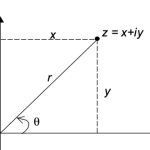
$$ z=x+iy\ i=\sqrt{-i}\quad, i^2=-1 $$
and z could be expressed in polar co-ordinate form as, $$ z=r(cos \theta+i\ sin\theta) $$ , where $$ x=r\ cos\theta \quad, y=r\ sin\theta $$ The set of all complex numbers is denoted \mathbb{C}; and for any complex number z, we could write z \in \mathbb{C}. ( \mathbb{R} \subset \mathbb{C} ).
6.2 Modulus
The modulus of z donates |z| is defined as, $$ |z|=r=\sqrt{x^2+y^2} $$
Modulus
6.3 Complex Conjugate
$$ \bar{z}=x-iy $$
For example, if z=x+iy, then \bar{z}=x-iy.
6.4 Polar Form
$$ z=r(cos\ \theta+i\ sin \ \theta)=re^{i\theta} $$
The pandemic damaged the international trading business. Sri Lanka is for its Tea (Ceylon), which accounts for about 10% of its total export, and textile and fabric products’ exports account for more than 40% of its total export. Export takes also a huge amount of total national income, though net export keeps negative over years. The country is highly vulnerable to changes in international business and policies. The Pandemic resulted in unprecedented damages to the whole economy. A brief path is shown in the following.
Pandemic blocked Export. The conflict between Ukraine and Russia increased the commodity price, which was highly reliable for Sri Lanka. Therefore, export decreased by decreasing quantity and import increased by increasing price, so the gap enlarged.
A falling down in Net Export made GDP decrease and Foreign Exchange Reserve Decrease.
Travelling industry was also blocked. National income from travelling decreased from more than 4 billion dollar to about 0.5 billion dollar.
Without enough Foreign Exchange Reserves, the FX rate became uncontrollable. LKR kept decreasing, and the government could not do a lot, because there is no space to buying back LKR.
In sum, the sources of national income is so simple that is easy to be affected by negative impulses.
In addition, changes in fiscal policy, tax cutting, in 2019 made the government unaffordable to government spending. The gov had to print money, which resulted in inflation and no real term increase. The fiscal policy negatively enhanced the difficulty of Sri Lanka.
The macroeconomy is significantly reflected by the Fed, the president of Fed, CB of each country, etc. The impacts on the economy are from two parts, one is the real policy implemented, the other is the sentiments (including the expectation of policy implementation.
In the most recently Jackson Hole ended two days ago, on Friday last week 26th Aug, Powell, who is the chair of Fed, showed his forceful attitude toward inflations. His speech disclosed that inflation is still in a high level, and not a place to stop or pause.
Personal Consumption Expenditure data is about 6.3%. Although PCE is less than in March, it’s still in a very high level.
The market reacted to the speech in Jackson Hole by a significant decrease, and also Bitcoin price, as a leading factor of market sentiment, dropped about 5% to less than 2k dollar. The market would definitely have reaction based on expectation. Personally, I am not optimistic toward the world Econ. Since the beginning of 2020, helicopter drops resulted in the unprecedented growth in the US market, the QT right now would force the market go back to the beginning adjusted with fundamental growth. Let’s see what would happen in the following months.
Powell insisted that the Fed will keep the 2% inflation target, coz high inflation rate would be harmful especially to the middle class and the poor. Therefore, he stated the Fed would keep QT and rise interest rate, and another 75 basis point increase in interest rate could possibly happens depending on the macro and statistical data.
My idea is coincidentally compatible with Powell’s. Although the market has foreseen the turning point of the inflation, the inflation rate is still in an extreme high level.
The market seemingly is pricing in the expectation that inflation would be about 4% by the end of this year. `Investing in Energy and Metal Commodity might still be a good choice.
China is facing a completely different problem. Low demands and high savings damage the economic growth, and the gov still choose to stimulate the Econ through the Real Estate, which is an ineffective way in my view. Chinese gov is lower the the long-term LPR, in order to rise mortgage loan and long-term investment loan, which could boost the econ growth in long term. However, the contradiction of monetary policy between US and CN is extracting the magnitude of our monetary policy. Starting to figure out a way to boost demand and keep developing high-barrier high tech industry seems a better path.